
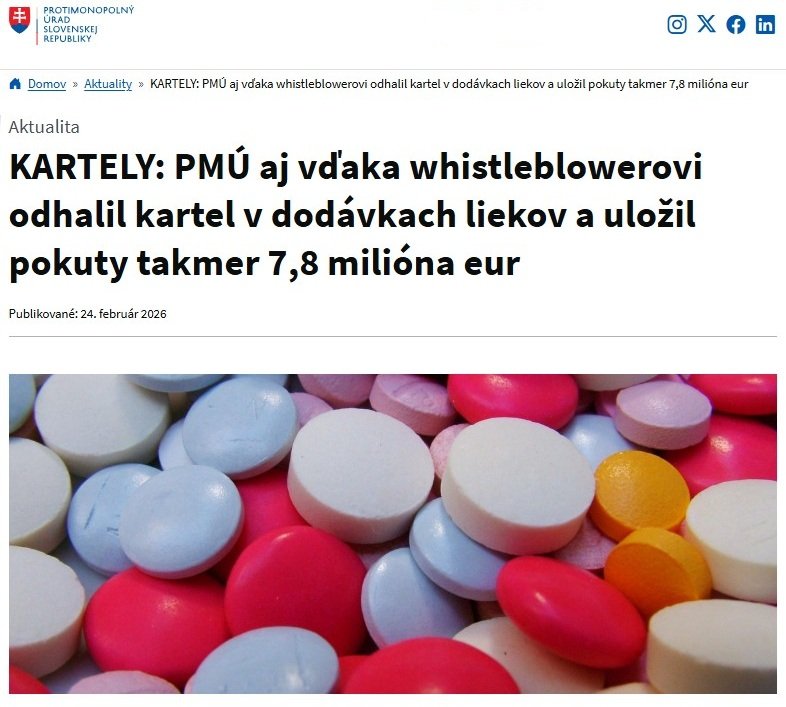
Earlier this year, Slovakia’s Antimonopoly Office (AMO) announced one of its most significant competition law decisions to date — uncovering a cartel in the supply of pharmaceuticals for public procurement and imposing fines totalling nearly €7.8 million. But what makes this case truly landmark is how it was cracked open: for the first time in Slovak history, a whistleblower played a decisive role in exposing the illegal scheme.
What happened?
The cartel involved the supply and distribution of categorised medicines for Všeobecná zdravotná poisťovňa (the General Health Insurance Company) and spanned from December 2017 to September 2020. During this period, competitors coordinated their behaviour — rather than competing fairly in public tenders — in one of the most serious forms of competition law infringement possible.
The AMO sanctioned two companies. PHOENIX Zdravotnícke zásobovanie received a fine of €7,595,200 and a one-year ban from public procurement. TRANSMEDIC SLOVAKIA (in bankruptcy proceedings) was fined €201,800 and banned from tenders for three years. PHOENIX’s fine was reduced as the company admitted its involvement and agreed to a settlement with the authority — a mechanism that allows for lower sanctions in exchange for cooperation and acceptance of responsibility.
The whistleblower factor
This is where the case becomes particularly important. The information provided by an individual whistleblower enabled the AMO to carry out an inspection and gather the necessary evidence — something that might never have happened otherwise. Slovak law incentivises this kind of reporting: the first person to provide decisive evidence is entitled to a reward of 1% of the fines imposed, up to a maximum of €100,000.
Previously, Slovak cartel cases were typically uncovered either through the AMO’s own investigations or through the leniency programme, where one of the participating companies chose to cooperate. This case marks a meaningful shift — an individual from within the industry came forward, and it made all the difference.
Why this matters for businesses
The message from this case is clear and worth sitting with: the risk of cartel exposure is no longer limited to external regulatory scrutiny. It now comes from within organisations themselves.
Whistleblower protection frameworks and financial incentives are beginning to have real, practical consequences in the Slovak market. For companies operating in regulated industries — and frankly, any industry involved in public procurement — this should prompt a serious look at internal compliance culture. Transparency and fair competition are no longer just reputational advantages. They are becoming a business necessity.
The AMO’s decision signals that cartels are being actively monitored, and that whistleblowing is emerging as a genuine and effective market oversight tool. The question for businesses is no longer just „will regulators find out?“ — it’s „will someone on the inside speak up?“
Photo source: Protimonopolný úrad Slovenskej republiky
https://www.antimon.gov.sk/kartely-pmu-aj-vdaka-whistleblowerovi-odhalil-kartel-v-dodavkach-liekov-a-ulozil-pokuty-takmer-78-miliona-eur/


 English
  Slovak